
Why a Repurchased Lemon Carries a Permanent Mark on Its Title in Ohio
Key Takeaways: Ohio’s Lemon Law requires manufacturers to repair warranty-covered defects that substantially impair a new vehicle’s use, value, or safety when the defect appears within the first year or 18,000 miles. If repair fails under ORC 1345.73(A) presumption triggers, three or more attempts at the same defect, 30 or more days out of service, eight or more total repair attempts, or one failed attempt on a life-threatening defect, a repurchase may follow. Once reacquired, Ohio requires the vehicle be branded a "buyback" on its title, a designation that remains with the car permanently as government-recorded disclosure to future buyers.
When a manufacturer buys back a defective vehicle under Ohio’s lemon law, that car does not quietly return to the used market with a clean history. Ohio law requires the vehicle’s title to carry a brand identifying it as a manufacturer buyback, and that designation travels with the car for life. For consumers fighting through repeated repair visits, understanding the branding rule confirms that the law treats a buyback as a formal, recorded event and protects the next buyer from inheriting your problem unknowingly.
If you are dealing with repeated warranty repairs on a 2020 or newer vehicle, the team at Jeffries Law is ready to review your repair history. Call 877-454-6045 or reach out to our team today to discuss what a buyback could mean for you.
What Ohio’s Lemon Law Actually Requires of Manufacturers
Ohio’s Lemon Law, known as the Nonconforming New Motor Vehicle Law, is codified at ORC 1345.71. The statute obligates manufacturers to repair a nonconforming vehicle so it conforms to the applicable express warranty. If they cannot do so within a reasonable number of attempts, the consumer may be entitled to either a replacement vehicle or a refund, with that choice generally belonging to the consumer under ORC 1345.72(B).
A "lemon" under Ohio law is a new vehicle with a warranty-covered nonconformity that substantially impairs its use, value, or safety. The defect must first appear within the first year following original delivery or during the first 18,000 miles, whichever comes first. That coverage window defines which vehicles may become buyback candidates subject to title branding.
Whether a defect substantially impairs use, value, or safety is fact-dependent. Courts and manufacturers may evaluate the same repair history differently, and outcomes depend heavily on documentation. Dealer and manufacturer repair orders are the primary evidence in a lemon law claim.
The Repair Attempt Triggers That Lead to a Vehicle Return
Ohio does not leave "reasonable number of repair attempts" to guesswork. Under ORC 1345.73(A)(1)-(4), a rebuttable presumption may arise when any one of four alternative conditions is met. Meeting even one trigger may support a claim for repurchase or replacement:
- The same nonconformity has been subject to repair three or more times and continues to exist
- The vehicle has been out of service for repair for a cumulative total of 30 or more calendar days
- There have been eight or more attempts to repair any nonconformity
- There has been one unsuccessful repair attempt on a nonconformity likely to cause death or serious bodily injury
The statutory clock can be extended in narrow circumstances. Under ORC 1345.73(B)(1)-(2), time periods may be extended for delays caused by war, invasion, civil unrest, strike, fire, flood, or natural disaster. During such extensions, the manufacturer must arrange for the use of a vehicle for the consumer at no cost. You can read the full text of Ohio’s reasonable repair attempts statute for the precise language.
\u{1F4A1} Pro Tip: Request a printed copy of every repair order before you leave the service department, and confirm the stated concern and days-out-of-service are recorded accurately. Gaps in paperwork can be common obstacles in proving a lemon law claim.
Understanding the Ohio Buyback Title Brand 1345.76 Framework
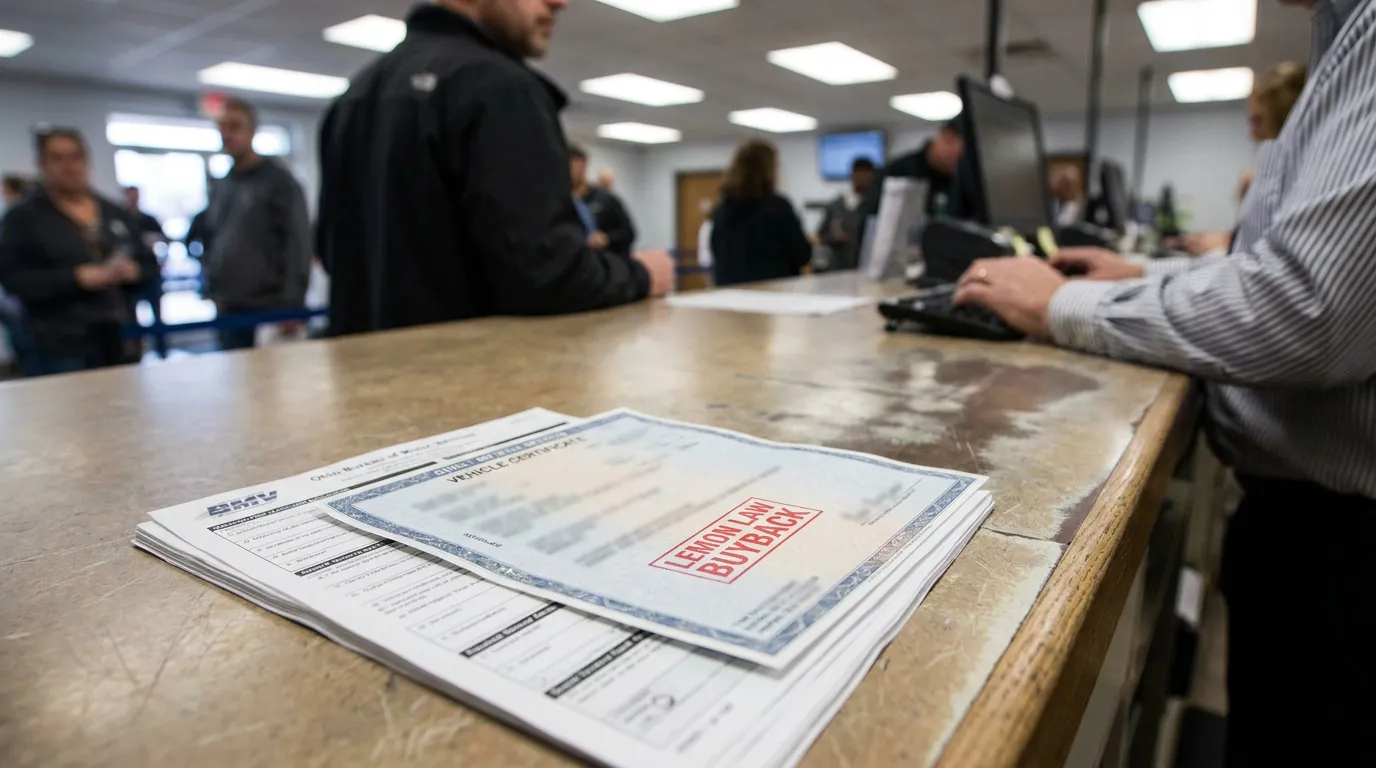
Ohio officially recognizes "buyback" as a title brand. Ohio BMV title processes list a title brand as one of several designations, including exceeded, salvage, non-actual, and buyback. That recognition indicates a manufacturer-repurchased lemon is flagged on the vehicle’s permanent title record. ORC 1345.76 separately imposes disclosure duties when a reacquired vehicle is resold.
The ohio buyback title brand 1345.76 framework reflects a broader policy: a vehicle’s history should be carried on and disclosed through its certificate of title. The same rationale drives Ohio’s related motor-vehicle title statutes, including ORC 4505.181, the title defect rescission provisions at ORC 1345.52, and the Odometer Rollback and Disclosure Act at ORC 4549.41.
Where the Brand Physically Appears
Branded titles in Ohio are issued at the county level, not by the BMV. Ohio titles are issued by Clerk of Courts title offices, so the buyback brand appears on the certificate of title produced by a county Clerk of Courts office. This matters if you need to review or challenge how a brand was applied.
Correcting a Wrong or Missing Brand
A wrongly applied or omitted brand can be corrected only through a formal review process. If the error originated with the county, the request goes back to the issuing Clerk of Courts title office. If the error came from a customer or dealer, the request goes to the BMV Title Support Section at 614-752-7671, and approval is not guaranteed.
Brand correction requests typically require notarized statements of fact detailing the error. These are submitted to the BMV’s titles email address or by fax, and the authority commonly cited includes ORC 4505.06, ORC 4505.10, and ORC 2921.13, the falsification statute. Because a false statement in this process can carry legal consequences, accuracy matters.
How Title Branding Protects the Next Buyer
The title branding requirement stops a reacquired vehicle from being resold as if nothing happened. A buyer shopping a used lot has little practical way to reconstruct a car’s warranty repair history, so the brand functions as a lasting, government-recorded disclosure.
Ohio law may give buyers a right to rescind in certain title-defect situations. Where a dealer lacked title on the purchase date and one of several enumerated defects applies, such as undisclosed rebuilt salvage status or inaccurate odometer disclosure, rescission may be available if the statutory conditions and deadlines are met.
| Ohio Title Protection | Governing Authority | Consumer Benefit |
|---|---|---|
| Buyback brand on title | ORC 1345.71 et seq. | Permanent disclosure of lemon history |
| Title Defect Recision Fund | ORC 4505.181; ORC 1345.52 | Refund when dealer fails to deliver valid title |
| Odometer disclosure rules | ORC 4549.41 | Accurate mileage on the certificate of title |
| Repair attempt presumption | ORC 1345.73(A) | Defined path to repurchase or replacement |
Ohio’s Enforcement Backstop for Title Problems
Ohio maintains a state-administered Title Defect Recision Fund that may reimburse eligible retail buyers harmed by certain dealer title failures. The fund may compensate purchasers when a dealer fails to provide a valid certificate of title in the purchaser’s name within the required time or fails to make required disclosures, subject to eligibility rules, filing deadlines, and statutory payment caps. Consumers can review how the Title Defect Recision Fund operates before deciding how to proceed.
Enforcement in this area can have real teeth. If the Attorney General pays a consumer on a dealer’s behalf through a TDR payout, the dealer may be required to reimburse the fund and obtain a surety bond going forward.
Who Handles Complaints
The Ohio Attorney General’s office has enforcement authority over consumer protection laws, including the Lemon Law and vehicle title statutes. Consumers who encounter title problems are directed to file a complaint online or by calling 800-282-0515, particularly where a dealer fails to obtain title within the statutory period, commonly 40 days after the sale. Keep in mind that an administrative complaint is separate from a civil lemon law claim, and filing one may not preserve civil deadlines.
A private lemon law claim and an agency complaint can proceed on different tracks. Civil statutes of limitations and administrative complaint procedures operate under different rules, so consumers should not assume action in one forum protects rights in the other. Ohio lemon law claims are also subject to their own filing deadline, and some manufacturers require participation in an informal dispute resolution program before certain remedies are pursued. If you want a fuller picture of what happens after a repurchase, this guide on vehicles deemed lemons walks through the process step by step.
\u{1F4A1} Pro Tip: If you are negotiating a repurchase, ask in writing how the manufacturer intends to handle the title brand and resale disclosure. The answer can reveal the manufacturer’s lemon law compliance posture.
Frequently Asked Questions
1. Does a buyback brand ever come off an Ohio title?
Generally, no. The brand is intended to be permanent. Removal is typically possible only where the brand was applied in error, and correcting it requires formal review through the issuing Clerk of Courts office or the BMV Title Support Section, with no guarantee of approval.
2. Does branding affect what I receive in a buyback?
The title brand attaches after the manufacturer reacquires the vehicle, so it does not reduce relief a consumer may be entitled to under ORC 1345.71 et seq. What you may recover depends on your repair history, purchase documents, statutory offsets, and how the claim is resolved.
3. What if my defect appeared after 18,000 miles?
The presumption under ORC 1345.73(A) applies to nonconformities arising during the first year or the first 18,000 miles, whichever comes first. Falling outside that window does not necessarily end every avenue of relief, warranty, federal Magnuson-Moss, or other consumer claims may still exist, but it may remove the statutory presumption.
4. Are my personal repair notes enough to prove a claim?
Dealer and manufacturer repair orders are the primary evidence in an Ohio lemon law claim. Your own notes, photographs, and calendars can supplement official documentation but typically carry less weight.
5. Who enforces disclosure when a branded vehicle is resold?
The Ohio Attorney General’s office is the relevant public enforcement authority for resale disclosure issues. Individual consumers may also have private remedies depending on the facts.
Bringing the Pieces Together Before You Act
Ohio’s approach to a returned lemon is deliberately transparent. The presumption triggers in ORC 1345.73(A) help define when a manufacturer’s duty to repurchase or replace may arise, and once a vehicle return occurs, the buyback designation is recorded on the certificate of title issued through a county Clerk of Courts office.
Every claim ultimately turns on its own facts. The number of repair attempts, the days out of service, the nature of the defect, and the completeness of service documentation all shape what relief may be available. Consumers with 2020 or newer vehicles facing repeated unresolved warranty repairs are well served by evaluating their options early rather than after the presumption window or filing deadline closes.
If your repair orders are stacking up and the same problem keeps returning, do not wait to get answers. Jeffries Law is prepared to review your documentation, and you can call 877-454-6045 or schedule a case review now to discuss your situation.
Disclaimer: This content is for informational purposes only and is not legal advice. Every case is unique, and results may vary. Consult an attorney about your specific circumstances.