
When the Same Problem Keeps Coming Back: Ohio’s Repair Attempt Rule Explained
Key Takeaways: Under Ohio Revised Code § 1345.73(A)(1), three repair attempts may trigger a presumption when substantially the same nonconformity has been subject to repair three or more times and the defect continues to exist or recurs. Visits do not need identical wording on repair orders and can occur at different authorized dealerships. The defect must substantially impair the vehicle’s use, value, or safety, and must arise within the first year or 18,000 miles, whichever comes first. Three attempts is one of four presumption paths, alongside 30 or more cumulative days out of service, eight or more total repair attempts, and one unsuccessful attempt on a serious safety defect. Itemized dealer repair orders are the primary evidence, and Ohio’s protections cover both leased and purchased vehicles.
Three repair attempts for the same defect may count under Ohio law when substantially the same nonconformity has been brought in for repair three or more times and the problem still exists or keeps returning. The attempts do not have to be identical on paper or occur at the same dealership. What matters is that the same underlying defect arose within the statutory protection period and kept failing to get fixed, and that the defect is serious enough to substantially impair your vehicle’s use, value, or safety.
If your 2020 or newer vehicle keeps going back for the same unresolved problem, you do not have to sort through the statute alone. The consumer advocates at Jeffries Law handle ohio lemon law cases with 3 repair attempts for the same nonconformity for drivers across the state. Call 877-454-6045 or reach out to our team today to have your repair history reviewed.
The Statutory Language Behind the Three-Attempt Standard
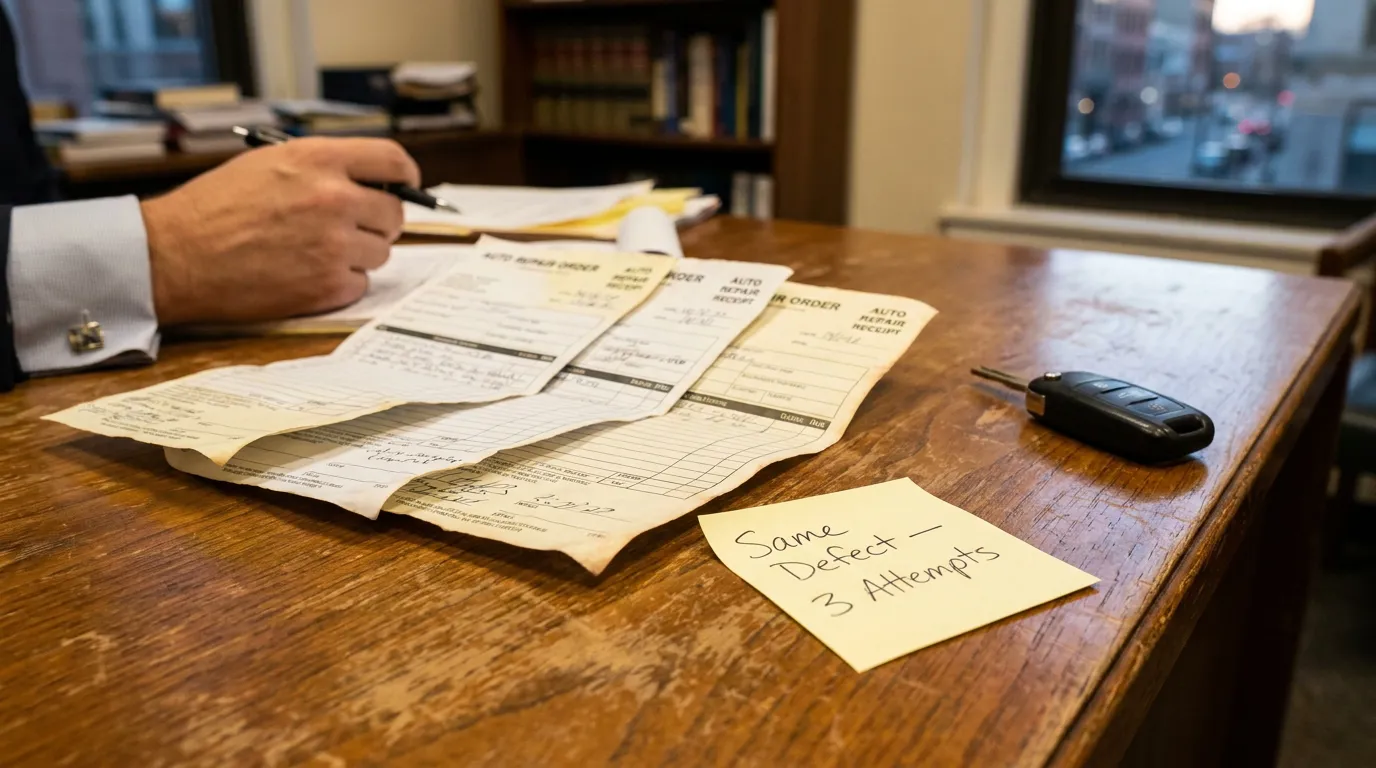
Ohio’s presumption of a reasonable number of repair attempts comes directly from statute, not dealer policy. Under Ohio Revised Code § 1345.73(A)(1), the presumption may apply when “substantially the same nonconformity has been subject to repair three or more times and either continues to exist or recurs.”
The phrase “substantially the same” carries real weight. Repair orders written by different service advisors often describe one defect in three different ways, and manufacturers sometimes argue those visits address separate issues. In many cases, the underlying nonconformity is the same mechanical or electrical failure, and that is the question a court or negotiation will turn on.
Why “Failure to Fix” Matters More Than Visit Count
Ohio’s test focuses on whether the defect was actually resolved, not merely on how many times you dropped the car off. The Ohio State Bar Association explains that the law reaches defects that cannot be or have not been properly repaired. A visit that fully and permanently corrects the problem generally does not build toward the threshold, because the statute requires that the nonconformity continue to exist or recur.
Understanding the Ohio Lemon Law 3 Repair Attempts Same Nonconformity Threshold
The Ohio Attorney General frames this as a question of whether the manufacturer received a reasonable opportunity to repair. Its guidance asks whether three or more attempts were made to repair one problem and the problem then continued or occurred again. Answering yes generally supports a demand for a replacement or refund, subject to the statute’s other conditions and any defenses the manufacturer raises.
Under ORC § 1345.73(A), repair attempts may count when undertaken by the manufacturer, its dealer, or its authorized agent. This means visits to different authorized dealerships can potentially aggregate. Moving across the state or changing service departments generally does not reset your count, though repairs by unauthorized independent shops typically will not count.
The Defect Must Be Substantial
Not every irritation qualifies as a nonconformity under the ohio lemon law standard. The defect must substantially impair the vehicle’s use, value, or safety. Under ORC Section 1345.71(E), a qualifying nonconformity is any defect or condition that substantially impairs the use, value, or safety of a motor vehicle and does not conform to the manufacturer’s express warranty. Conditions resulting from abuse, neglect, or unauthorized modification are not excluded from the definition itself, but instead serve as an affirmative defense available to the manufacturer under ORC Section 1345.75(D). Persistent transmission slipping, stalling, brake failure, steering problems, or electrical faults that disable safety systems typically qualify far better than a trim rattle.
Whether a defect rises to that level is fact-dependent. Courts may consider the nature of the failure, its frequency, its safety implications, and its effect on resale value.
💡 Pro Tip: When you schedule service, describe the recurring problem the same way each time. Consistent language across repair orders may make it easier to show that the visits addressed substantially the same nonconformity.
Timing: The Protection Period That Controls Everything
The nonconformity must arise and be reported during the protection period. ORC § 1345.73(A) frames the presumption around one year following the date of original delivery or the first eighteen thousand miles of operation, whichever is earlier.
There is an important nuance. Ohio’s repair duty under ORC § 1345.72 attaches to nonconformities reported within the protection period, and repair efforts for such a defect commonly continue past that period. A defect discovered at month eleven that the dealer chases for another six months may still support a claim, though the outcome depends on the records and arguments raised.
The statute also contemplates limited extensions. Under ORC § 1345.73(B)(1)-(2), the one-year and 18,000-mile periods may be extended by any period during which the vehicle could not be reasonably repaired due to war, invasion, civil unrest, strike, fire, flood, or natural disaster. These provisions are narrow and rarely applied.
Three Attempts Is Only One of Four Paths
Ohio provides four alternative triggers, and generally only one needs to be satisfied. Consumers sometimes give up because they logged two same-defect repairs, without realizing another route may already be open.
|
Trigger under ORC § 1345.73(A) |
What it requires |
|---|---|
|
Same nonconformity |
Three or more repair attempts; defect continues or recurs |
|
Days out of service |
30 or more cumulative calendar days out of service for repair |
|
Multiple defects |
Eight or more total repair attempts on any nonconformity within the first year or 18,000 miles |
|
Serious safety defect |
One unsuccessful attempt on a defect likely to cause death or serious bodily injury that still exists or recurs |
If your service history shows many visits spread across different problems, it is worth reviewing what 8 repair attempts mean under Ohio’s Lemon Law before assuming you fall short.
Documentation: What Actually Proves Your Repair Attempts
Dealer and manufacturer repair orders are typically the primary evidence in any lemon law claim. Ohio’s consumer guidance from the Attorney General notes that dealers should give you a fully itemized written work order each time you take your vehicle in for repairs, listing your stated concerns, the work attempted, and the parts used.
Practical steps that often strengthen ohio lemon law qualifying repairs include:
-
Requesting a copy of the itemized work order before you leave the service drive
-
Confirming that your stated concern appears on the order, not just the technician’s diagnosis
-
Keeping loaner and rental paperwork, which helps establish days out of service
-
Saving text messages and emails with the service department that reflect ongoing complaints
💡 Pro Tip: If a repair order says “could not duplicate,” that visit may still count as a repair attempt. Ask that your complaint be recorded verbatim so the visit is documented even when nothing is repaired.
Leased Vehicles and the Relief Available
Ohio’s lemon law may reach both purchased and leased vehicles. According to the Ohio State Bar Association’s overview of consumer lemon law protections, the statute requires manufacturers to replace or buy back an owned or leased vehicle under certain circumstances.
Once the presumption is met, the consumer typically notifies the manufacturer in writing, ideally by certified mail, identifying the problems, the repair attempts, the VIN, and whether a refund or replacement is sought. Under ORC § 1345.72(B), the choice generally rests with the consumer. Before filing suit, a consumer may first have to use the manufacturer’s informal dispute resolution program if that program complies with ORC § 1345.77. Under Ohio Revised Code Section 1345.75, a lemon law action must be brought within five years of the date of original delivery of the motor vehicle.
Frequently Asked Questions
1. Do all three repair attempts have to be at the same dealership?
Generally no. ORC § 1345.73(A) counts attempts undertaken by the manufacturer, its dealer, or its authorized agent, so visits to different authorized service centers may aggregate toward the threshold. Work by unauthorized shops typically will not count.
2. What if each repair order describes the problem differently?
The statutory phrase is “substantially the same nonconformity,” not identical wording. Differently worded orders often describe one underlying defect, though manufacturers may dispute that, and the outcome depends on the specific records.
3. Does a visit count if the dealer could not reproduce the problem?
It may. Because Ohio’s ohio lemon law repair attempt definition focuses on whether the defect was properly repaired, an unsuccessful diagnostic visit for the same complaint can support your position, subject to how the visit was documented.
4. My third repair happened after 18,000 miles. Am I out of luck?
Not necessarily. If the defect arose and was reported within the first year or 18,000 miles, whichever came first, continued repair efforts after that point may still support a claim, though whether they count toward the presumption can be contested.
5. What relief can I ask for once the presumption applies?
The remedy is generally a replacement vehicle or a refund, with the consumer choosing between them. Under ORC Section 1345.72, a refund must include the full purchase price along with all collateral charges, finance charges, and incidental damages. Ohio’s lemon law contains no statutory formula for a mileage-based usage deduction, making it one of the strongest consumer refund protections in the country.
Where This Leaves Ohio Drivers Stuck in the Repair Loop
Ohio’s three-attempt rule is more flexible than many consumers assume and stricter than others hope. The reasonable number of repair attempts in Ohio generally turns on whether substantially the same nonconformity persisted after three or more tries, whether the defect substantially impairs use, value, or safety, and whether the problem surfaced within the first year or 18,000 miles. Even then, the result is a rebuttable presumption rather than an automatic win.
If the same defect keeps returning to your 2020 or newer vehicle, a review of your repair orders is the sensible next step. Jeffries Law represents consumers, never manufacturers, in Ohio lemon law claims. Call 877-454-6045, visit our lemon law claims resources, or request a case review to discuss your options.
Disclaimer: This content is for informational purposes only and is not legal advice. Every case is unique, and results may vary. Consult an attorney about your specific circumstances.