
When a Diesel Truck Slows Itself Down: Understanding DEF Derate in Texas
Key Takeaways: DEF system limp mode is a staged engine derate that restricts power and can cap a diesel truck’s speed at 5 to 25 miles per hour when the diesel exhaust fluid system reads low fluid, poor fluid quality, or a failed sensor, injector, or pump. That level of restriction may substantially impair a vehicle’s use, safety, or market value, the core requirement under the Texas Lemon Law in Texas Occupations Code Chapter 2301, Subchapter M. A DEF derate may qualify if the defect arose during the original warranty period and an authorized dealer received a reasonable number of repair attempts, which Texas presumes through one of three tests: four attempts for the same defect, two attempts for a serious safety hazard, or 30+ cumulative days out of service, each with its own timing requirements. Dealer repair orders are generally the controlling evidence, so owners should request printed copies and confirm the stated complaint accurately describes the derate. Implied warranty of merchantability rules and deceptive trade practices provisions in the Business and Commerce Code may apply alongside the Lemon Law. Deadlines matter, because the TxDMV administrative complaint window and the four-year civil accrual period run separately and can end a claim early.
If your diesel truck suddenly limits its speed to a crawl and flashes a DEF warning, you’re experiencing what most drivers call limp mode. A recurring DEF-related derate may qualify under the Texas Lemon Law if it substantially impairs the vehicle’s use, safety, or market value, appeared during the warranty period, and an authorized dealer had a reasonable number of chances to repair it. Whether a truck meets those elements depends heavily on the repair history documented by the dealership.
If your truck keeps entering reduced power mode and the dealer can’t fix it, the team at Jeffries Law is ready to review your repair orders. Call 877-454-6045 or contact us now to discuss your options with a DEF system limp mode lemon law lawyer.
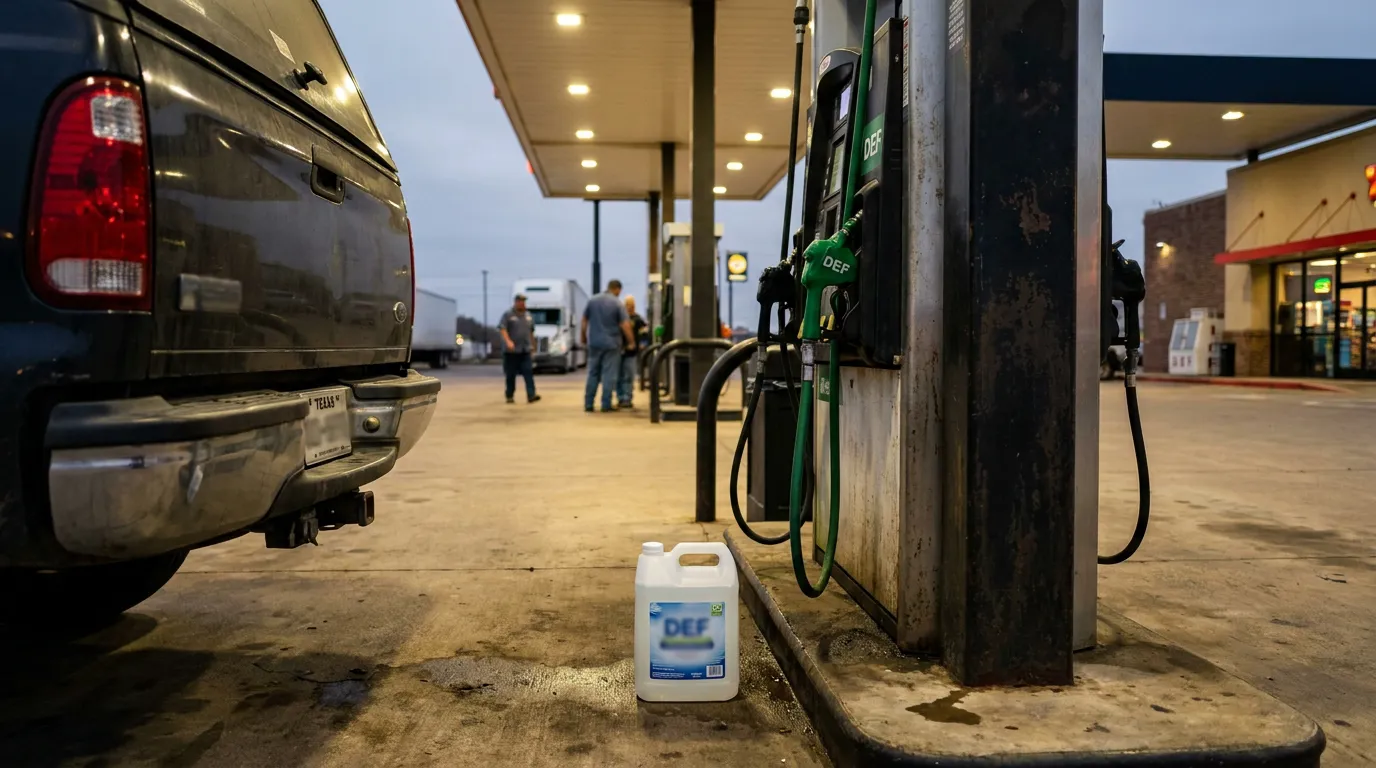
What DEF Limp Mode Actually Does to Your Truck
Diesel exhaust fluid systems neutralize nitrogen oxide in exhaust gases, and modern diesel engines are generally programmed to limit operation when that system fails. When a sensor reads low fluid, poor fluid quality, or a malfunctioning injector or pump, the engine control module may trigger a staged derate, first restricting engine output, then capping road speed at roughly 5 to 25 mph, and sometimes limiting restarting after shutdown.
The severity of that restriction is one reason DEF failures can matter legally. A truck capped at walking pace generally can’t tow, haul, or safely merge onto a highway. Owners frequently report being stranded, missing delivery windows, or losing work days waiting for dealership appointments.
Why Manufacturers Build Derate Into the System
Federal and state clean-air requirements drive the design of these emissions controls. Texas Transportation Code § 541.203(1) defines an "exhaust emission system" as an engine modification designed to control or reduce emissions, installed in compliance with the Motor Vehicle Air Pollution Control Act. Whether DEF systems and their derate function fall within that definition isn’t settled, and the definition matters mainly for Transportation Code purposes rather than Lemon Law eligibility.
Texas Health and Safety Code § 382.202(d) requires the Department of Public Safety to implement emissions inspection programs in counties designated under the state’s air quality plan. Derate strategies help manufacturers ensure compliance and discourage tampering, but that doesn’t necessarily excuse a system that malfunctions repeatedly on a properly maintained vehicle.
Does a DEF System Limp Mode Lemon Law Claim Qualify in Texas?
The Texas Lemon Law, in Texas Occupations Code Chapter 2301, Subchapter M, generally covers new vehicles with a defect that substantially impairs use, market value, or safety. The Texas Lemon Law consumer guide explains that owners must show the manufacturer or dealer received a reasonable number of repair attempts while under original warranty, and that the owner gave written notice and an opportunity to cure. A DEF derate returning after multiple documented visits may satisfy the substantial impairment element, though the agency decides case by case.
Texas generally establishes a presumption of "reasonable number of attempts" through three tests, each tied to specific time and mileage windows. The four-times test requires two repair attempts for the same defect in the first 12 months/12,000 miles, plus two more in the following 12 months/12,000 miles. The serious safety hazard test requires two total repair attempts within the first 24 months or 24,000 miles, whichever comes first, for a defect that is a life-threatening malfunction substantially impeding the ability to control or operate the vehicle, or creating a substantial risk of fire or explosion. The 30-day test requires the vehicle out of service 30+ cumulative days within 24 months/24,000 miles, with at least two attempts in the first 12 months/12,000 miles and no comparable loaner provided. Owners often reach one of these thresholds with emissions failures, since DEF parts are frequently backordered. Failing a presumption doesn’t automatically defeat a claim, but makes it harder to prove.
The Qualifying Tests at a Glance
| Qualifying Test | General Threshold | What Records Prove It |
|---|---|---|
| Four-times test | Four repair attempts for the same DEF defect across two 12-month/12,000-mile periods | Dated dealer repair orders showing the same complaint |
| Serious safety hazard test | Two repair attempts within the first 24 months or 24,000 miles for a life-threatening malfunction substantially impeding vehicle control or creating a substantial risk of fire or explosion | Repair orders plus documented derate or stall events |
| 30-day test | 30+ cumulative days out of service within 24 months/24,000 miles, no comparable loaner | Service-in and service-out dates on dealer invoices |
Dealer and manufacturer repair orders are generally the primary evidence in a Texas claim. Your own log of dates, mileage, and symptoms is useful supplementary material, but the repair order typically controls the legal analysis. Request a printed copy at every visit and confirm the stated complaint reflects what you reported.
💡 Pro Tip: Ask the service advisor to note the specific derate stage and speed limitation on the repair order. Vague entries like "customer states check engine light" make it harder to prove the same defect recurred.
Deadlines That Can End a Claim Before It Starts
Two separate clocks may run at once, under different bodies of law. The administrative Lemon Law complaint filed with the TxDMV generally must be submitted no later than six months after the earliest of: the express warranty’s expiration, 24 months from original delivery, or 24,000 miles, subject to the agency’s own eligibility rules. This window is distinct from any civil statute of limitations.
On the civil side, Texas Business and Commerce Code § 2.725(a)-(b) requires an action for breach of a sales contract within four years after accrual. A breach of warranty generally accrues at tender of delivery, not discovery, except where a warranty explicitly extends to future performance. Courts read that exception narrowly, and tolling arguments are fact-dependent. Other theories, like DTPA claims, carry their own limitations periods, so owners benefit from reviewing dates early.
Warranty Standards a Derating Truck May Fail
Texas commercial law supplies benchmarks that may apply alongside the Lemon Law. Under Texas Business and Commerce Code § 2.314(a), a warranty of merchantability is implied when the seller is a merchant of goods of that kind. Section 2.314(b)(3) requires merchantable goods to be fit for their ordinary purposes. This implied warranty can be disclaimed by conspicuous contract language, so the sale documents matter.
A truck that repeatedly enters reduced power mode may fail that standard, since its ordinary purpose is reliable hauling and driving. The statute also requires goods to conform to promises made and be of fair average quality, giving owners practical yardsticks when a manufacturer insists the derate is "normal operation." Whether a particular failure pattern rises to breach remains fact-specific.
Deceptive Trade Practices Considerations
Texas Business and Commerce Code § 17.46(a) declares false, misleading, or deceptive trade practices unlawful. A private DTPA suit generally requires conduct within the statute’s enumerated categories, and the plaintiff must qualify as a consumer who relied on the conduct to their detriment. This may apply if a dealer or manufacturer conceals or misrepresents a known, recurring DEF defect during sale or repair. Some owners learn only later that technical service bulletins addressed their exact symptom.
The statute treats knowing and intentional conduct more seriously, with additional damages available only at the fact-finder’s discretion. Under § 17.45(13), acting "intentionally" includes actual awareness of the defect or falsity, coupled with specific intent that the consumer act in detrimental reliance. Proving awareness is challenging and depends on internal records obtained through the legal process.
Who Is Actually Responsible for the Defect
Responsibility for Lemon Law relief usually rests with the manufacturer rather than the selling dealership. Texas Transportation Code § 503.001(10) defines "manufacturer" as a person who manufactures, distributes, or assembles new vehicles, and Occupations Code Chapter 2301 has its own governing definitions. Repurchase or replacement relief is generally directed at the manufacturer, converter, or distributor, while a dealer may face separate warranty or DTPA exposure.
The dealership still plays a central role. Franchised dealers perform warranty repairs, generate repair orders, and set the days-out-of-service count. That’s why owners should generally return to an authorized dealer rather than an independent shop when a derate appears, even if the independent option seems faster.
How the Texas Complaint Process Works
Texas generally routes Lemon Law disputes through an administrative process, which doesn’t by itself eliminate separate civil warranty remedies. Owners file with the TxDMV, which handles eligibility screening, mediation, and, when appropriate, a formal hearing. Review the agency’s own TxDMV Lemon Law complaint process before filing.
Preparation matters more than speed at this stage. Owners should gather:
- Every dealer repair order, including service-in and service-out dates
- The purchase or lease agreement and warranty booklet
- Written notice sent to the manufacturer describing the defect
- Photographs or video of dashboard derate warnings and speed limitations
- A mileage and date log supporting, not replacing, dealer records
This administrative track is generally separate from any civil warranty lawsuit, governed by different rules and deadlines. Many owners also wonder whether their repair count is sufficient; our discussion of whether a vehicle can qualify after 4 repair attempts addresses that threshold in more detail.
💡 Pro Tip: Keep the truck in service until the repair is genuinely complete. Picking it up early can reduce your cumulative days out of service and weaken the 30-day test.
Frequently Asked Questions
1. Does low DEF fluid count as a defect?
Generally no, running the tank low is typically treated as normal maintenance, not a defect. A qualifying claim generally involves a malfunction in the sensors, heater, injector, pump, or control software that triggers a derate despite properly filled, in-spec fluid. Keeping fluid purchase receipts may help counter a manufacturer’s neglect argument.
2. My truck is used for business. Do Texas vehicle owner rights still apply?
Coverage can extend to commercial purchasers, but it’s fact-dependent. Eligibility often turns on the vehicle’s gross weight rating, titling, and purchase structure, and DTPA claims carry their own limits for larger commercial transactions. An attorney review of your title and purchase documents is the practical way to answer this.
3. What if the dealer says it cannot duplicate the derate?
A "no problem found" entry may still count as a documented repair attempt, though manufacturers routinely dispute it. Ask that the visit be written up rather than handled informally. Capturing video of the dashboard warning when it occurs can help the technician reproduce the failure.
4. Can I still act if my warranty just expired?
Possibly, depending on when the defect was first reported. The Lemon Law generally requires the defect to have arisen and been reported during the warranty period, and the administrative complaint must still be filed within the six-month window even if repairs continue afterward. Separate warranty claims follow their own four-year accrual rules, subject to narrowly-applied exceptions.
5. What relief is available if my claim succeeds?
Outcomes may include repurchase, replacement, an agency repair order, or a negotiated settlement. Repurchase amounts are typically reduced by a statutory offset for the owner’s use of the vehicle, and the result depends on the vehicle, defect history, and manufacturer’s position. No outcome can be promised in advance, since every file turns on its own evidence.
Putting Your Repair History to Work
A recurring DEF derate isn’t something you have to accept as the cost of owning a modern diesel. Texas law may provide meaningful protection through the Lemon Law’s substantial impairment standard, implied warranty rules, and deceptive trade practices provisions, any of which could apply to a truck that repeatedly drops into reduced power mode. Success generally depends on complete dealer repair orders, written notice to the manufacturer, and attention to deadlines that often run from delivery rather than discovery.
If your diesel truck keeps derating and the dealership has run out of answers, talk with a lemon law attorney at Jeffries Law’s Texas team about your next step. Call 877-454-6045 or request a free case review today to have your repair history evaluated.
Disclaimer: This content is for informational purposes only and is not legal advice. Every case is unique, and results may vary. Consult an attorney about your specific circumstances.